Shopify Agentic Commerce: How Order Editing Works When Customers Buy via AI
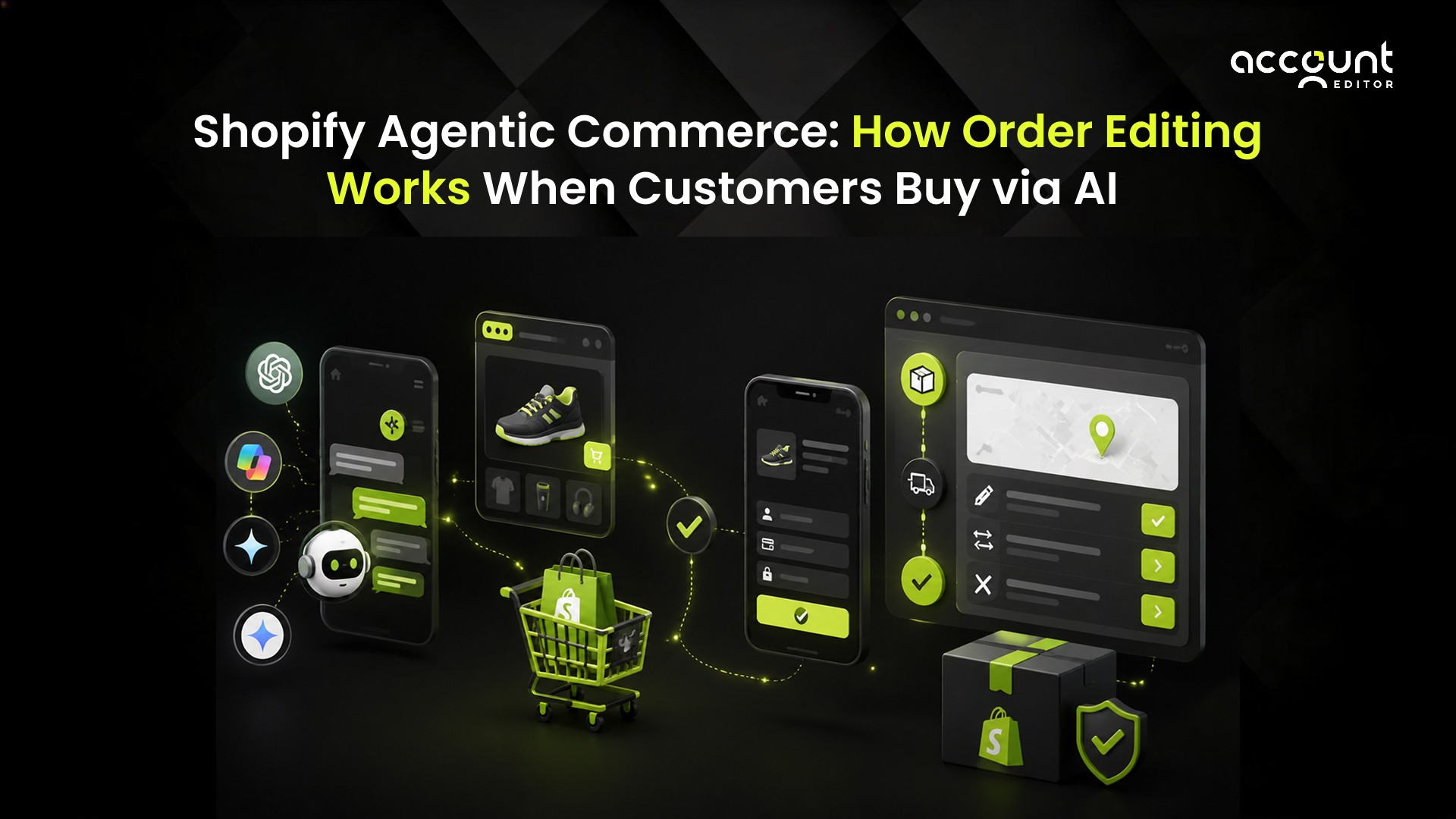
In March 2026, Shopify activated Agentic Storefronts by default for every eligible US merchant. Overnight, around 5.6 million Shopify stores became discoverable inside ChatGPT, Microsoft Copilot and Google AI Mode— no integration work required. The new sales channel shipped with attribution, real-time catalog sync, and a clear architectural choice: discovery happens inside the AI conversation, and purchases complete on the merchant's own storefront.
The AI agent finds the product, the buyer taps "buy," the merchant's checkout opens in an in-app browser or new tab — and from that moment, the post-purchase experience is back in the merchant's hands. Same Order Status page. Same email confirmations. Same need for self-serve order editing when the buyer realises something is wrong.
Except the buyer is different. They arrived high-intent, mobile-first, often with less time on a product page than a typical storefront shopper. The post-purchase mistakes they make — wrong size, wrong address, wrong variant — happen faster and more often. This guide breaks down what changes in your Shopify post-purchase stack when buyers come through agentic commerce, and what the new traffic actually demands.
What Is Shopify Agentic Commerce?
Shopify Agentic Commerce is the model where AI agents — like ChatGPT, Microsoft Copilot, Google AI Mode and Gemini— help customers discover, compare, and buy Shopify-merchant products inside a conversation. Shopify surfaces product data from millions of stores through a centralised catalog, and the AI agent presents matching options as part of its reply to a shopper's question.
The core components:
Agentic Storefronts. Shopify's sales-channel feature, activated by default for eligible US merchants in late March 2026, that makes a store's catalog discoverable across major AI platforms.
Shopify Catalog. The data layer Shopify uses to normalise product information so AI agents can understand and present it accurately.
Universal Commerce Protocol (UCP). Open standard co-developed by Shopify and Google, backed by Visa, Mastercard, Stripe, Amazon, Walmart, Target and others — covers discovery, cart, checkout, and post-purchase.
Agentic Commerce Protocol (ACP). OpenAI and Stripe's open standard, focused primarily on checkout and payments inside ChatGPT.
Shopify Agentic Plan. A new plan that lets brands on any commerce platform list products in the Shopify Catalog to reach AI channels.
What stays the same: orders flow into the Shopify admin with channel attribution, merchants remain the merchant of record, and the customer relationship — including the entire post-purchase experience — stays with the merchant.
How the Agentic Buyer Journey Actually Works
The journey runs through five fast steps:
A shopper asks an AI agent a buying question. "Best running shoes under $150" or "gifts for a coffee enthusiast" or "navy linen shirt for summer."
The agent surfaces matching products. Ranking factors include catalog data quality, availability, pricing, and the AI platform's own relevance signals. Rankings are organic — not paid placements.
The shopper taps a product they like. On mobile, ChatGPT opens the merchant's storefront in an in-app browser. On desktop, it opens in a new tab. Copilot and Google AI Mode offer an embedded checkout variant.
Checkout completes on the merchant's site. Shopify processes payment, tax, fraud, and fulfilment exactly as it would for any other order.
The order appears in the merchant's admin with channel attribution. Same Shopify order record, with a new referrer source flag showing whether it came from ChatGPT, Copilot or Gemini.
By step four, the AI agent's role is essentially complete. The conversation that started the journey may continue elsewhere, but the order, the customer data, the fulfilment timeline, and every post-purchase touchpoint live with the merchant.
Where the Agentic Conversation Ends and Post-Purchase Begins
This is the part most "how to sell in ChatGPT" guides skip. Once the buyer taps "Place order," the agentic-commerce conversation drops away. There is no native interface inside ChatGPT for editing an order they just placed on your storefront. There is no "change my address" button in Gemini once the order is in Shopify. The post-purchase experience reverts to standard Shopify infrastructure:
Order confirmation email triggered by the merchant's Shopify
Order Status page accessible from the email, the same surface every traditional buyer sees
Customer support channels owned by the merchant — email, chat, social
Returns and exchanges processed through whatever returns tooling the merchant runs
Shopify is explicit about this in its Agentic Storefronts documentation: for orders placed through these channels, the merchant retains full ownership of the customer relationship and post-purchase experience. The discovery layer is agentic. The action layer for everything after checkout is the merchant's storefront, exactly as it was before AI channels existed.
Why Post-Purchase Editing Matters More When Buyers Come From AI Channels
Agentic-acquired traffic behaves differently from organic-search traffic. A few patterns are worth naming:
Shorter consideration time before purchase. AI agents pre-qualify buyers and surface a narrow set of options. By the time the shopper lands on your storefront, they've already decided in conversation. The full product-page evaluation that traditional buyers do — reading reviews, checking sizing charts, comparing variants — often gets compressed or skipped entirely. That compression shows up afterwards, when the buyer realises the order wasn't quite right.
Mobile-first impulse purchasing. Most ChatGPT shopping happens on mobile through an in-app browser. Shop Pay accelerates the checkout. Friction is at its absolute minimum, which is excellent for conversion — and slightly dangerous for post-purchase accuracy. Wrong-size, wrong-quantity, and wrong-address tickets historically spike when checkout friction drops.
AI-conditioned expectations carry into post-purchase. A buyer who just had a conversation with an AI that knew their preferences, their budget, and their previous order history expects that same level of convenience when something needs fixing. What they don't want is to write an email to support, wait six hours, and play three rounds of "can you confirm your order number." They expect self-service.
The buyer may never return to your storefront organically. Agentic-channel buyers came through a conversation, not through your homepage. They don't necessarily have your URL bookmarked. Their primary post-purchase entry point is the email confirmation and the Order Status page link inside it. Those two surfaces become more important than they were when traditional buyers had multiple paths back to the brand.
Add these patterns together and a clear pattern emerges: the agentic channel produces high-intent buyers who are also more likely to need a post-purchase edit, and less patient with the friction of getting it.
The Post-Purchase Gap Most Agentic-Ready Stores Haven't Filled
Walk through what a typical Shopify store has done to prepare for agentic commerce in 2026:
Discovery layer: Shopify Agentic Storefronts active. Product data in Shopify Catalog. Knowledge Base content audited so AI agents can answer policy questions accurately. ✓
Checkout layer: Shop Pay enabled. Mobile checkout optimised. In-app browser experience tested. ✓
Fulfilment layer: 3PL or in-house fulfilment unchanged — same systems handle the new traffic. ✓
Post-purchase action layer: Often still the same email-to-support workflow that existed before agentic channels arrived. ✗
That last gap is the customer experience cliff. The buyer just had a magical AI-led discovery experience, a one-tap Shop Pay checkout, and a beautifully designed confirmation email. Then they realise they typed the wrong apartment number — and the only path to fix it is to reply to the email and wait for a human to respond.
The merchants who win in agentic commerce will be the ones who design the post-purchase layer to match the conversion experience that brought the buyer in. That means reducing the friction of edits, putting them on the same Order Status page the buyer is already pointed to, and resolving common mistakes in seconds rather than hours.
The merchants who win in agentic commerce will be the ones who design the post-purchase layer to match the conversion experience that brought the buyer in. That means reducing the friction of edits, putting them on the same Order Status page the buyer is already pointed to, and resolving common mistakes in seconds rather than hours.
Designing a Post-Purchase Layer for Agentic-Channel Buyers
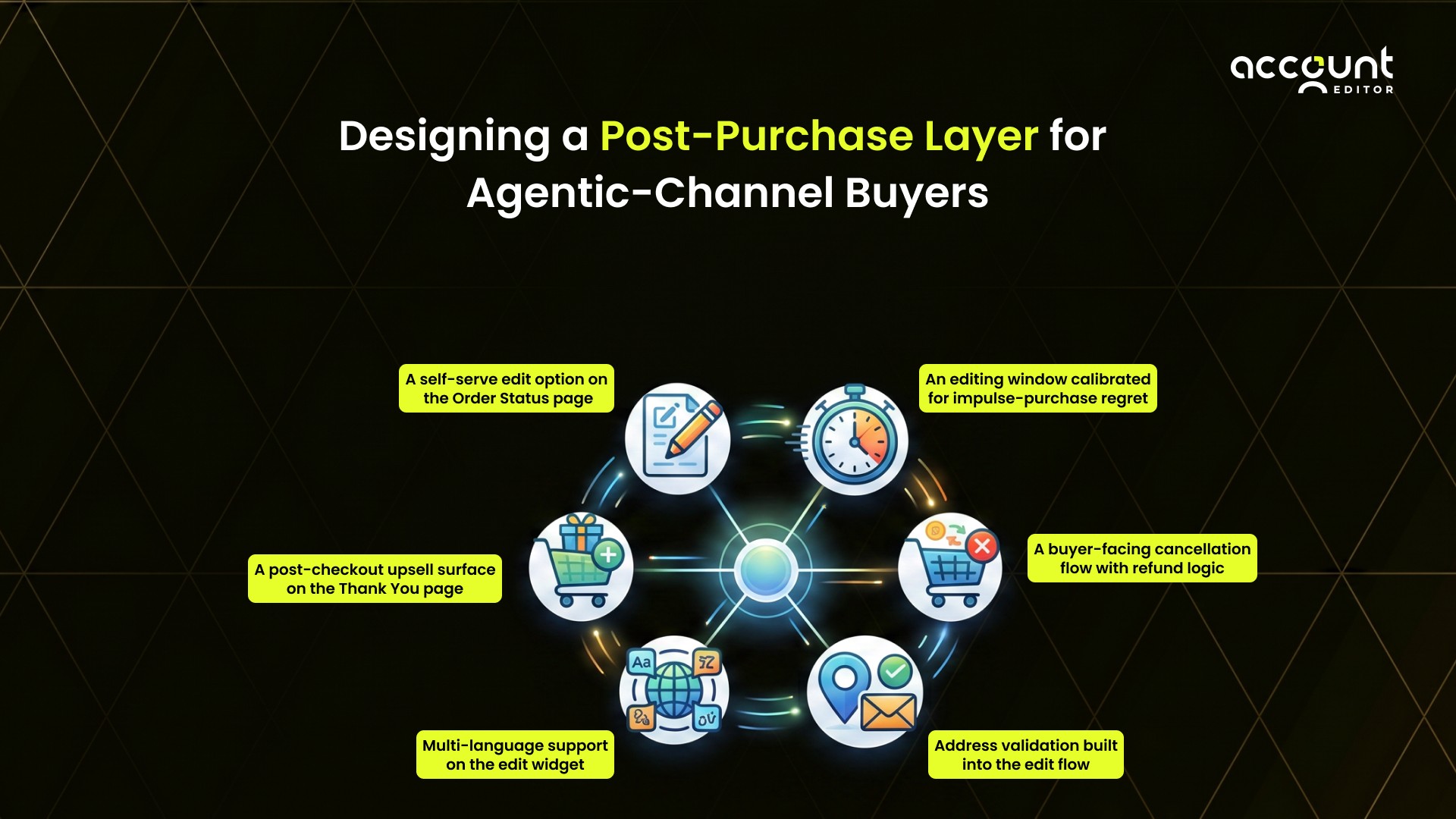
The good news is that the infrastructure required works identically for agentic-channel and traditional buyers. The buyer journey converges at the Order Status page, regardless of where it started. Here's what to build into that layer:
A self-serve edit option on the Order Status page. Address fixes, contact details, quantity adjustments, variant swaps, and item additions or removals, completed by the buyer themselves inside a merchant-defined editing window.
An editing window calibrated for impulse-purchase regret. Fast-shipping DTC stores may want a tight window (15 minutes to a few hours). Pre-order and made-to-order stores can run weeks. The right window matches your fulfilment SLA, not a default.
A buyer-facing cancellation flow with refund logic. Agentic-channel buyers are more likely to second-guess a purchase. A self-serve cancellation flow with merchant-defined rules — restocking fees, refund-to-original or store credit, fulfilment-status checks — keeps that decision contained inside your post-purchase layer rather than escalating to a chargeback.
Address validation built into the edit flow. AI-channel buyers are mobile-first; mobile-typed addresses are typo-prone. Google Maps validation catches issues at the edit moment.
Multi-language support on the edit widget. Agentic commerce is expanding globally. A buyer who interacted with the AI in French expects the same experience on your post-purchase surface.
A post-checkout upsell surface on the Thank You page. Agentic-channel buyers arrive pre-qualified and high-intent — exactly the audience most likely to add a complementary product in one click after their initial purchase.
None of this is agentic-commerce-specific infrastructure. It's the same Order Status page and Thank You page that every Shopify store has. The difference is that agentic channels make these surfaces matter more, because the buyer's journey to them is faster and their patience for friction is lower.
How Account Editor Fits the Agentic Commerce Post-Purchase Layer
Account Editor operates on the Order Status page and Thank You page — the surfaces every Shopify order routes through, regardless of acquisition channel. An order placed via ChatGPT, Copilot, Google AI Mode, or a traditional storefront visit all land on the same post-purchase infrastructure. The widget renders identically.
Inside a merchant-defined editing window, customers can update shipping addresses with Google Maps validation, change contact details, adjust quantities, swap variants, add or remove items, cancel within your rules with refund logic applied, and accept post-checkout upsells in one click. Multi-language and right-to-left rendering ship out of the box, which matters as agentic commerce expands beyond the US
Conclusion: Agentic Commerce Doesn't Change Your Post-Purchase Layer — It Raises the Bar for It
Agentic commerce is real. According to Shopify's own commerce reporting, AI-driven traffic to Shopify stores has grown roughly 8x year-over-year since January 2025, with AI-attributed orders up 15x in the same window. The discovery surface has fundamentally shifted from search engines and social feeds to conversational AI. Your products are now showing up in conversations you can't see, with buyers you've never met, on platforms you don't control.
What does stay under your control is everything that happens after the buyer taps "Place order." The Order Status page is yours. The email confirmation is yours. The customer relationship is yours. The post-purchase experience is the layer that defines whether agentic-channel buyers become repeat customers — and whether the high-intent traffic AI is sending you compounds into LTV or evaporates into refunds and chargebacks.
If your post-purchase layer today still routes every change request through email-to-support, the agentic channel will expose that gap fast. The buyer who came from a one-tap AI conversation expects a one-tap post-purchase fix. Install Account Editor free on Shopify and give every buyer — agentic-channel or otherwise — the self-serve layer the modern Shopify post-purchase experience demands.