7 Reasons Order Editing Apps Are Becoming Essential for Shopify Stores in 2026
A shopper completes checkout, feels good about the purchase, and then it hits them.
“Wait… I ordered the wrong size.”
“That’s my old address.”
“I forgot to add another item.”
In a traditional ecommerce setup, that single moment of panic turns into frustration, emails, support delays, cancellations, refunds, and sometimes… no reorder at all. But today’s customers shop differently; they expect flexibility. They want control. And they want the freedom to fix mistakes after checkout without being forced to cancel. That expectation is now driving the explosive rise of Shopify order editing, self-serve order editing, and seamless Shopify post-purchase editing experiences in 2026. With smarter systems powered by AI-driven order automation, real-time changes, and automated approval logic, editable orders are shifting from a “nice perk” to an industry standard.
Simply put: If your store doesn’t allow editable orders, your customers will choose one that does.
What Is Order Editing on Shopify?
Order editing simply gives customers the flexibility to update or change details on their order after checkout, without needing to cancel or restart the entire purchase process. It removes friction, prevents mistakes from turning into cancellations, and creates a smoother e-commerce post-purchase experience.
Definition: Order editing is the ability for customers or merchants to update an order after checkout, without cancelling it. This includes changing products or variants, correcting the shipping address, adjusting quantities, adding or removing items, or fixing mistakes before fulfillment begins. Order editing helps prevent cancellations, reduces support requests, and improves post-purchase accuracy in Shopify stores.
Here’s what customers can typically do when a store supports editable orders:
Edit order after checkout
This allows customers to make changes immediately after placing an order, when mistakes are most commonly noticed. It eliminates the need to wait for support or request refunds, which significantly improves the Shopify customer experience and reduces frustration.
Modify Shopify order after purchase
Customers can adjust product selections such as colours, sizes, or styles through easy post-purchase editing tools. This helps merchants avoid unnecessary cancellations, while giving shoppers more confidence and control over their purchase decisions.
Fix delivery details using the update shipping address in Shopify
Incorrect addresses are one of the top causes of failed deliveries and RTO losses. By enabling address correction and allowing buyers to update their shipping addresses on Shopify before fulfillment begins, merchants prevent expensive logistics errors and delays.
Adjust quantities or change variants using post-purchase product modifications
Whether a shopper wants to upgrade from 1 to 3 units, swap product sizes, or choose a different variant, post-purchase product modifications make adjustments effortless without requiring cancellation or backend manual edits.
Add forgotten items, apply missed deals, or remove duplicates
Customers often want to add something immediately after purchase, especially if they realized they missed a discount, forgot a bundle pack, or accidentally ordered duplicates. With self-serve order editing, these small corrections become seamless and frustration-free.
Today’s buyer behaviour reflects this shift, and the demand is rising.
Search queries such as:
“Can customers edit their Shopify order after purchase?”
“How to edit order details on Shopify?”
“Can you change the address after placing a Shopify order?”
…are increasing month after month, showing that editable orders are no longer just a convenience; they’re becoming a shopper expectation.
While Shopify does offer basic native editing functionality, it’s limited in flexibility, especially for:
Shopify Plus merchants
Bundled or complex product setups
Multi-warehouse or automated fulfillment workflows
That’s why most brands choose to install a dedicated order editing app on Shopify, like Account Editor. With features like order modification, Shopify automation, real-time syncing, and customer-initiated order updates, account editor ensures edits are accurate, smooth, and fully aligned with Shopify’s backend and fulfillment systems, without requiring manual support intervention.
Want to dive deeper into how editable orders improve retention and post-purchase satisfaction? Read our guide. How Post-Purchase Workflows Boost Customer Retention
Why Order Editing Apps Are Becoming Essential in 2026
Just a great product, no longer drives E-commerce, it’s driven by predictability, speed, accuracy, and above all, customer flexibility. Shoppers expect control over their orders even after checkout, and brands that deliver this freedom are seeing higher satisfaction, fewer cancellations, and smoother operations. Modern customers want the ability to fix mistakes instantly. Merchants want processes that run themselves through automation and AI-driven workflows. Fulfillment teams want clear, accurate order data with no last-minute surprises. Editable orders deliver on all three expectations simultaneously.
This is where the shift happens:
Traditional e-commerce treats checkout like a locked door; once the order is placed, nothing can be changed without support intervention. It’s rigid, outdated, and creates friction. But the new era of ecommerce treats checkout like a flexible checkpoint, where customers can continue shaping their order until fulfillment begins. This shift aligns with rising demand for:
Shopify post-purchase editing
Customer-driven order updates
Order modification Shopify workflows
Shopify workflow optimization
By enabling editable orders, brands eliminate the barriers that once led to cancellations, operational chaos, and elevated support overhead. 2026 is the year when personalization meets automation, and editable orders sit right at that intersection. Now, let’s explore the seven powerful reasons why Shopify order editing has evolved from a “nice extra” to an absolute necessity for high-performing ecommerce businesses.
7 Reasons Order Editing Apps Are Becoming Essential for Shopify Stores
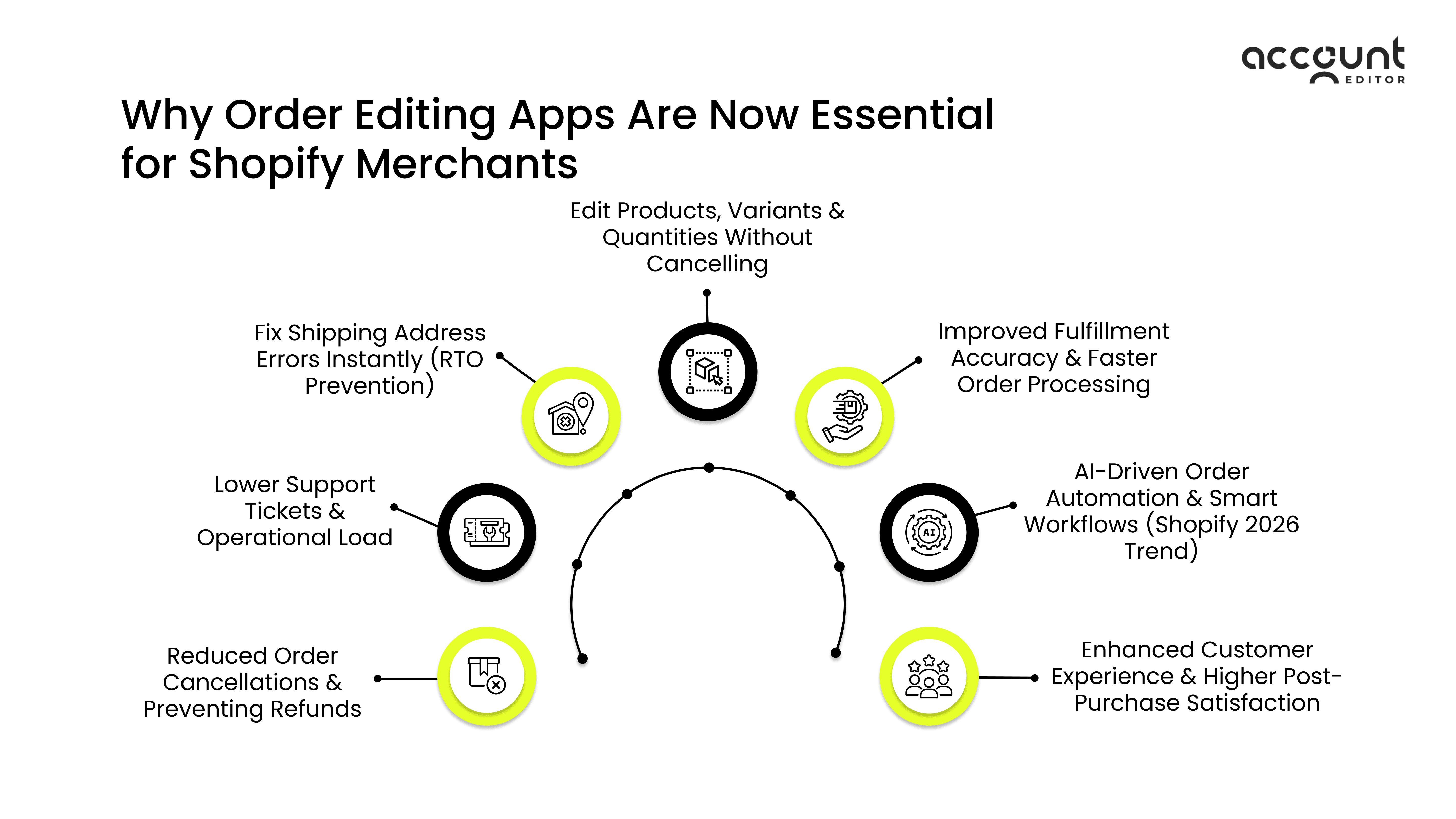
1. Reduced Order Cancellations & Preventing Refunds
One of the biggest hidden revenue leaks in e-commerce is preventable cancellations. In most cases, shoppers aren’t backing out because they regret the purchase; they’re cancelling because they made a simple, human mistake. Maybe they chose the wrong size, forgot an item, picked the wrong colour, or mistyped the address. Without self-serve order editing, these small mistakes create big problems. Customers panic, abandon the order, or request a full cancellation, and many never come back to complete the purchase. But with post-purchase flexibility and a seamless Shopify order editing workflow, that frustration disappears. Instead of cancelling, customers simply click “Edit Order,” fix the issue, and continue confidently.
Merchants using Account Editor, one of the leading order editing apps in Shopify solutions, have reported a 30–40% reduction in cancellations (learn how to reduce Shopify order cancellations using automation and post-purchase workflows). This happens because customers can easily:
Correct variant choices (size, colour, model, style)
Add or remove items without creating a new order
Adjust product quantities in real-time
Fix address details instantly using the update shipping address Shopify
Avoid starting over from scratch
This is powerful because it directly addresses the root causes of most cancellations and transforms them into successful conversions. Not only does this eliminate unnecessary refunds, but it also prevents accidental duplicate orders, which happen when customers attempt to reorder manually after a cancellation. These duplicates create fulfillment confusion, increased support load, and wasted inventory.
Every cancellation prevented :
• revenue saved
• support workload reduced
• fulfillment accuracy improved
• customer trust strengthened
In a competitive e-commerce landscape, giving shoppers the ability to edit orders after checkout is one of the simplest yet most impactful ways to protect revenue and create a hassle-free e-commerce post-purchase experience.
2. Lower Support Tickets & Operational Load
Support teams should never be stuck manually fixing preventable issues such as sizes, incorrect colours, shipping address mistakes, or missing add-ons. These are routine errors that cost time, slow down fulfillment, and drain valuable support resources. With customer-driven order updates, fully automated post-purchase optimization workflows, and customers handling these corrections themselves without waiting for support intervention. This instantly eliminates the most repetitive requests and reduces dependency on manual edits.
Merchants who enable self-serve order editing consistently see:
50%+ fewer support tickets related to order errors, because customers can easily perform an order edit, adjust items, fix details, or update shipping address. This transforms support teams from reactive order-fixers into proactive customer success specialists. Instead of battling order mistakes, they focus on meaningful conversations like product guidance, loyalty building, and resolving complex issues.
Reduced manual intervention means dramatically fewer:
• Typos
• Communication delays
• Fulfillment mistakes
• Misrouted orders
• Internal processing errors
All of this is made possible through intelligent customer support automation that connects order editing directly with your fulfillment flow, ensuring accuracy at every step. This is why order editing becomes more than convenience; it becomes a transformative operational upgrade.
3. Fix Shipping Address Errors Instantly (RTO Prevention)
Even the smallest mistakes, such as missing an apartment number, a wrong pin code, or a single mistyping of a single digit, can derail an entire order. Incorrect shipping details are one of the biggest contributors to failed deliveries, and the consequences are costly.
Failed deliveries often result in:
Costly RTO fees (Return to Origin charges)
Lost product due to damage or non-returnable items
Additional reshipment costs
Delays that frustrate shoppers
A wave of negative reviews that damages long-term brand trust
With address correction,features and a seamless, self-service option to update shipping address, customers can fix delivery details instantly before the order reaches fulfillment. This prevents last-minute errors, removes the need for support involvement, and dramatically lowers the chances of delivery failures. To date, Account Editor has processed over 137,000+ successful address edits, helping merchants eliminate avoidable logistics issues and protect both margin and customer satisfaction. These real-time corrections ensure that orders reach the right place the first time, improving operational efficiency across the board. For international brands, fast-shipping operations, or subscription-based businesses, this capability isn’t just convenient, it’s essential. A single corrected address can save the cost of an entire shipment, making self-serve order editing one of the highest-ROI upgrades a merchant can adopt. With the right tools, what used to be a costly mistake becomes a simple, instant fix, and that’s the power of smart post-purchase automation.
4. Edit Products, Variants & Quantities Without Cancelling
It’s completely normal for customers to rethink their purchase moments after checking out. In fact, this “post-purchase reconsideration” is one of the most common shopper behaviours, and it’s also one of the biggest sources of unnecessary cancellations when stores don’t support editable orders.
Shoppers often realize they want:
A different colour
A different size or variant
A bundle instead of a single product
An extra item they forgot to add during checkout
Without a flexible system, these simple changes force customers to cancel and start over, creating friction and risking lost revenue. But with product change capabilities and seamless post-purchase modifications, customers can update their order instantly, without contacting support or restarting the process.
This is why Account Editor, the leading order editing app on Shopify, becomes a game-changer. It allows customers to:
Swap variants
Update sizes
Add or remove items
Adjust quantities
Upgrade to better bundles
Improve their order without friction
So far, Account Editor has processed 41,000+ product adjustments, proving just how essential flexible editing has become for modern shoppers. This isn’t just a convenience; it’s a core part of creating a superior customer experience.
And here’s the revenue-driving advantage:
When customers can modify their orders instead of cancelling, they often increase average order value (AOV) by adding items or upgrading products. What would have been a lost sale becomes an opportunity to grow revenue. With the right post-purchase editing system, merchants don’t just save orders; they enhance them.
5. Improved Fulfillment Accuracy & Faster Order Processing
When customers can edit orders, the entire fulfillment process becomes clearer, smoother, and dramatically more efficient. One of the biggest operational bottlenecks in e-commerce is uncertainty; warehouse teams often aren’t sure whether a customer emailed a change, whether support updated it, or whether a message went unnoticed. But with a structured order editing system in place, the order always reflects the final, approved, and customer-confirmed version. No guessing. No last-minute surprises. No miscommunication between teams.
This shift creates massive operational clarity and leads to:
• Fewer picking errors, because only the updated product list reaches fulfillment
• Faster processing times, since orders don’t get held back for edits or confirmations
• Lower return rates, as the correct items are shipped the first time
• Better inventory accuracy, with real-time adjustments synced instantly
Modern e-commerce success depends heavily on accurate fulfillment, and order editing is one of the most effective ways to minimize waste, reduce mistakes, and prevent costly reshipments. By enabling features such as post-purchase order changes, order modifications, and real-time syncing through tools like Account Editor, merchants empower their fulfillment teams to work confidently, not reactively. The result is a smoother supply chain, fewer operational disruptions, and a more reliable delivery experience for customers. Order editing isn’t just a customer convenience; it’s a critical component of fulfillment efficiency for high-volume Shopify merchants.
6. AI-Driven Order Automation & Smart Workflows (Shopify 2026 Trend)
This is the moment where the future of e-commerce becomes unmistakably clear. Modern tools like Account Editor have moved beyond basic post-purchase edits into AI-driven order automation, transforming how Shopify stores operate at scale.
Instead of relying on manual decisions or support intervention, the system automatically evaluates and manages key editing criteria, such as:
• Which orders are eligible for editing, based on fulfillment status, location, or product type
• How long does the edit window remain open, ensuring customers have flexibility without disrupting fulfillment
• What types of edits are allowed, including variant swaps, quantity changes, or post-purchase product modifications
• Whether approval is required, depending on merchant rules, inventory thresholds, or order value
These intelligent, rule-based workflows are at the core of emerging Shopify automation trends 2026, giving merchants the ability to automate repetitive decision-making and drastically reduce manual workload.
The result?
Highly accurate workflow execution
Faster decision-making
Fewer fulfillment delays
Reduced operational complexity
A more seamless post-purchase editing experience for customers
In 2026, editable orders aren’t just convenient, they are smart. They adapt to your business, enforce your rules, and power a fully optimized workflow automation system that scales effortlessly alongside your growth. With apps like Account Editor, order editing becomes an intelligent, fully automated extension of your store, eliminating friction and elevating both customer experience and operational efficiency.
7. Enhanced Customer Experience & Higher Post-Purchase Satisfaction
People don’t just want a product, they want a smooth, forgiving, and flexible shopping experience. Rigid order systems create stress. Modern shoppers expect brands to understand that mistakes happen and to make those mistakes easy to fix.
By offering self-serve order editing, Shopify brands immediately elevate the overall buying experience. Customers feel:
• More trust, because the brand gives them control
• More convenience, with no need to message support for simple corrections
• More emotional satisfaction, knowing errors can be fixed instantly
• More loyalty and repeat purchase behaviour, because the experience feels genuinely customer-first
Customers always remember when a brand makes fixing mistakes simple, and they remember even faster when a small error turns into a frustrating or costly problem. That’s why editable orders matter so much. They turn the post-purchase journey into a smooth, stress-free experience where shoppers feel in control, not restricted.
Brands that offer this flexibility instantly appear more modern, transparent, and trustworthy. A seamless eCommerce post-purchase experience also helps reduce buyer’s remorse and gives customers more confidence to press “Buy Now,” knowing they can adjust details later.
By 2026, editable orders won’t just improve operations; they’ll elevate your brand and strengthen long-term customer relationships. In a competitive e-commerce landscape, that level of trust becomes a genuine growth advantage.
Bonus: Why Shopify Stores Need a Self-Serve Order Editing System Now
Editable orders are no longer a futuristic concept; they’re rapidly becoming the industry standard across the most competitive sectors of e-commerce. Brands operating in:
Subscription commerce, where recurring orders require frequent adjustments
High-volume retail, where even small errors can scale into major operational failures
Global fulfillment, where address accuracy is critical, and shipping costs are high
Shopify Plus environments, where complex workflows and fast fulfillment demand precision
…are all adopting self-serve order editing solutions as a core part of their operations.
In this new landscape, a dedicated order editing app, such as Account Editor, is not just an optional enhancement, it’s an essential upgrade for merchants who want to scale smoothly and competitively. Offering editable orders prevents cancellations, reduces customer frustration, and eliminates the support burden caused by avoidable mistakes.
Brands that adopt editable orders now gain:
Smoother post-purchase optimization
Fewer fulfillment disruptions
Increased revenue retention
Stronger Shopify customer experience
Operational efficiency that competitors can’t match
But brands that delay this upgrade risk falling behind rapidly shifting customer expectations. Modern shoppers simply don’t tolerate rigid, irreversible order systems anymore. They expect flexibility as a standard part of buying online.
In 2026 and beyond:
Those who enable editable orders lead the industry. Those who don’t fall behind and lose customers who expect better.
Now is the moment to evolve your post-purchase experience and position your brand for the next era of e-commerce.
Conclusion: The Future of Shopify Post-Purchase Workflows
The e-commerce landscape is undergoing a major transformation, shifting away from rigid, unforgiving systems and moving toward flexible, customer-controlled workflows. Shoppers no longer accept the idea that once they click “Buy,” their order is final. They expect the freedom to correct mistakes, update details, and improve their purchase without hassle.
The outdated model of:
Cancel → Refund → Reorder
is quickly being replaced with the modern, customer-first approach:
Edit → Confirm → Fulfill
This shift is powered by smart tools that support Shopify order editing, real-time post-purchase flexibility, and seamless customer-driven order updates, allowing shoppers to take control without disrupting operations. Editable orders don’t just make the buying experience better. They directly impact the bottom line.
They:
Protect revenue by preventing avoidable cancellations
Improve fulfillment accuracy through updated order data
Reduce support dependency, eliminating repetitive manual tasks
Enhance the e-commerce post-purchase experience, building trust and loyalty
In 2026 and beyond, offering editable orders is no longer a nice enhancement. It is a foundational requirement for modern Shopify commerce. Brands that embrace this future will operate more efficiently, earn higher customer satisfaction, and outperform competitors still stuck in outdated systems. If you want a Shopify store that feels modern, flexible, and customer-centric, editable orders are not optional. They are essential.