How Self-Service Order Editing Creates a Better Customer Experience for your Shopify store
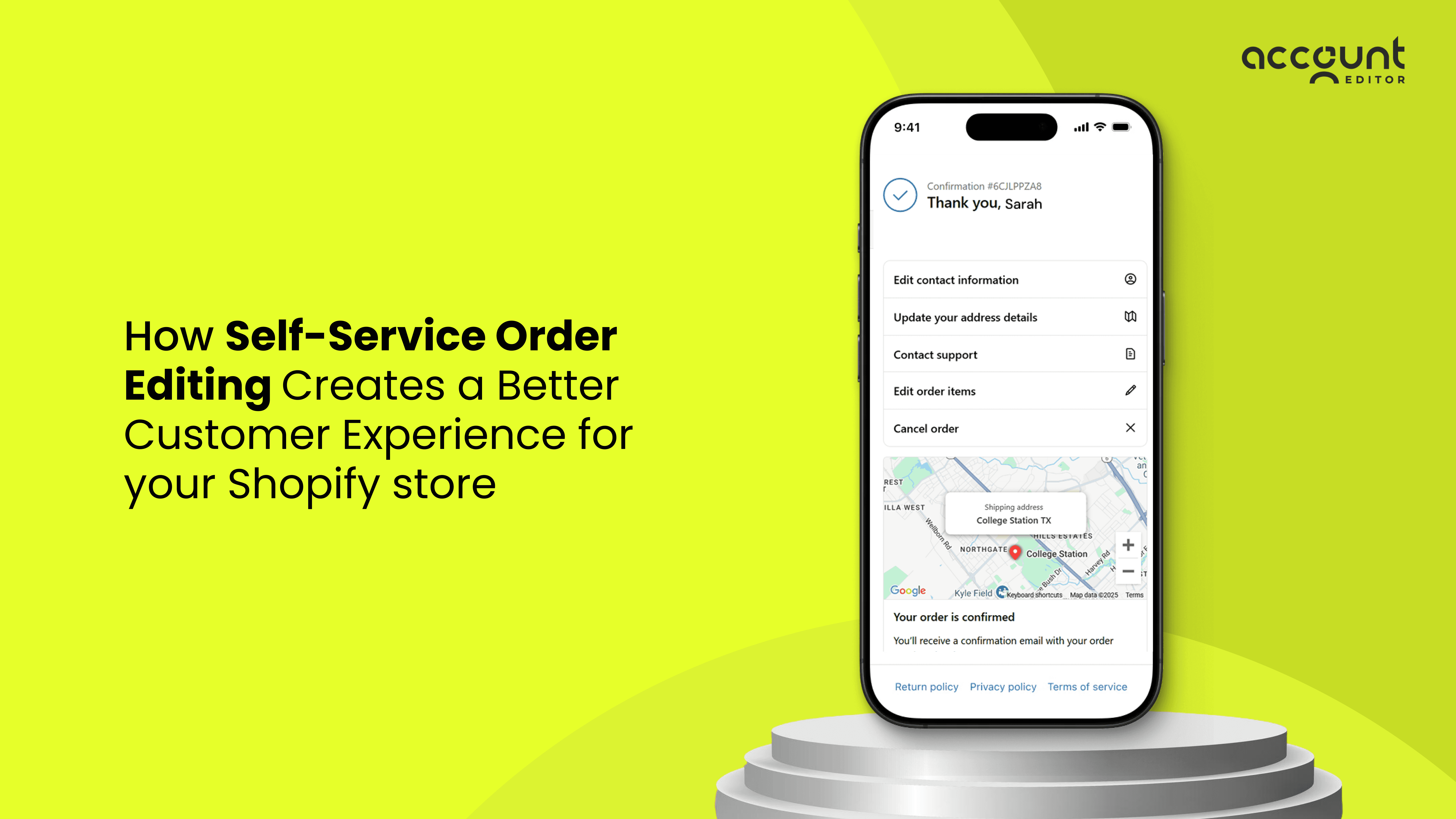
The post-purchase phase is one of the most overlooked areas in eCommerce, yet it’s where brands win loyalty or lose customers. In fact, 76% of consumers say the post-purchase experience is the most memorable part of their shopping journey. Shoppers today expect autonomy, speed, and flexibility, not long email threads or delayed support responses.
This is why self-service order editing, especially within Shopify, has become a strategic advantage rather than a “nice-to-have.” When customers can fix mistakes instantly, like updating a size, modifying quantities, choosing the right variant, or using Edit shipping address Shopify features—they feel in control. And when customers feel empowered, customer satisfaction, repeat purchases, and LTV naturally increase.
Shopify’s native tools offer very limited options for editing orders, making it difficult for customers to resolve issues without contacting support. The result? More support tickets, more order cancellations, and more frustration on both ends.
This is exactly where modern solutions like Account Editor change the game by enabling true self-serve order editing, reducing errors, and shaping a smoother, more customer-friendly post-purchase experience.
How self-service order editing shapes the customer experience
When you enable self-serve order editing or use a Shopify app for self-serve order editing, you shift from reactive customer support to proactive customer empowerment.
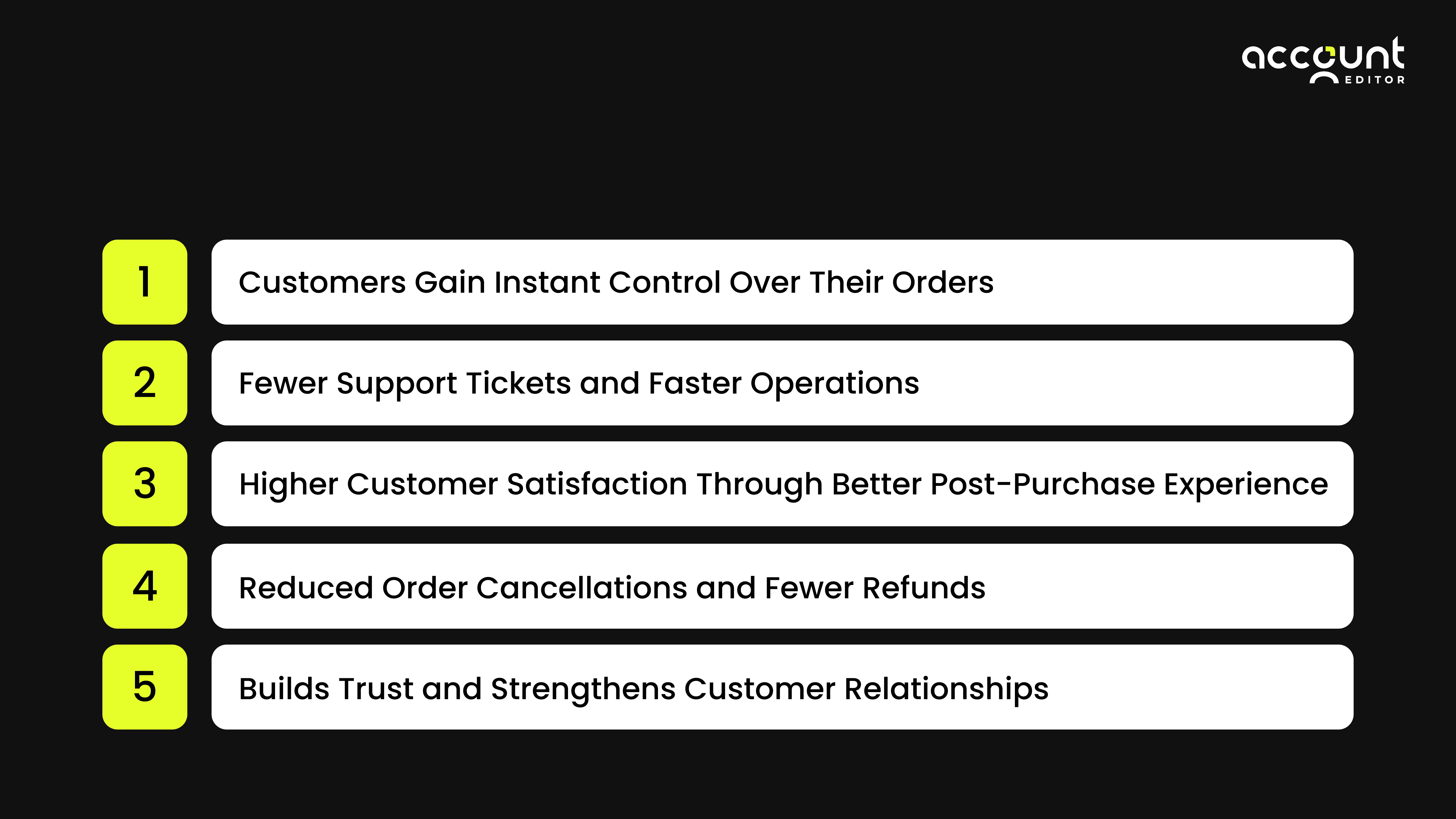
1. Customers Gain Instant Control Over Their Orders
Giving shoppers the power to correct mistakes immediately, without contacting support dramatically improves the Shopify customer experience. With self-service order editing, customers can fix errors the moment they notice them, eliminating the stress and uncertainty that usually follows a purchase. This sense of autonomy reduces friction and makes the post-purchase journey feel smooth and predictable.
What customers can instantly modify:
• Wrong shipping address they entered by mistake
• Item size, color, or variant
• Quantity changes
• Misspelled email or phone number
• Items they forgot to add or want to remove
In short:
When customers have the option of self-serve order editing, they feel in control and control builds trust.
2. Fewer Support Tickets and Faster Operations
A major benefit of post-purchase order changes is the immediate drop in support queries. Most Shopify stores face dozens of daily emails asking, “Can you edit my order?” or “Can you change my address?”, all of which are repetitive, time-consuming, and prevent support teams from focusing on higher-value interactions.
How this reduces operational pressure:
• Removes up to 40–60% of “please edit my order” messages
• Eliminates last-minute fulfillment delays
• Reduces manual data entry errors from staff
• Allows support teams to prioritize complex queries
• Increases fulfillment accuracy by minimizing rushed corrections
In short:
When customers can edit their Shopify orders themselves, your support team finally gets breathing room and fulfillment becomes faster and more reliable.
3. Higher Customer Satisfaction Through Better Post-Purchase Experience
Shoppers judge a brand not just by the checkout experience, but by what happens after. Allowing self-serve order editing creates a smoother, more reassuring post-purchase experience, which translates to better reviews, higher repeat purchase rates, and stronger brand loyalty. When customers feel supported after checkout, they’re far more likely to come back.
What makes the experience better:
• Anxiety drops because changes can be made instantly
• The brand feels modern, responsive, and customer-first
• Every step becomes predictable and transparent
• Delays and refund frustrations are minimized
In short:
Easy post-purchase order editing replaces uncertainty with reliability, boosting customer satisfaction and repeat business.
4. Reduced Order Cancellations and Fewer Refunds
A large portion of order cancellations happen simply because customers can’t fix a mistake. When shoppers enter the wrong address or choose the wrong variant, the quickest solution is often cancellation, unless you offer self-service order changes. By giving customers a window to correct issues, merchants prevent unnecessary cancellations and keep revenue that would otherwise be lost.
Why cancellations decrease:
• Customers fix errors instead of cancelling
• Wrong-address orders no longer require refunds
• Variant mistakes can be corrected instantly
• Customers can add forgotten items instead of placing a second order
• Misclicks or accidental purchases become easy to correct
In short:
When customers can correct mistakes, cancellations drop and revenue stays where it belongs, with the merchant. To understand the importance of self-serve order editing in reducing cancellations, read our related blog.
5. Builds Trust and Strengthens Customer Relationships
Trust is at the core of every exceptional customer experience. When brands give shoppers the ability to manage and edit their own orders, it signals transparency, confidence, and customer-centric thinking. This builds long-term loyalty and turns one-time buyers into repeat customers.
Why trust increases:
• Shoppers don’t feel “locked in” after checkout
• Transparency reduces post-purchase anxiety
• You demonstrate respect for the customer’s time
• Customers feel taken care of before issues escalate
• Mistakes don’t lead to blame or frustration
In short:
Brands that enable self-service customer workflows earn stronger trust and customers return because they feel valued.
What about self-service order cancellations?
Offering self-service order cancellations is essential for a smooth Shopify customer experience, especially when paired with self-service order editing. When shoppers catch a mistake like wrong shipping address, missing item, incorrect size, or a forgotten discount, they expect a quick way to fix it. Research shows 72% of shoppers expect simple post-purchase changes, and cancellation is often the only available option when editing isn’t.
The surprising truth is that most cancellations aren’t signs of lost interest, they’re attempts to correct orders. Many merchants discover that a majority of cancellation requests come from customers who still want the product, but need to fix something they couldn’t adjust themselves. Studies show that 12–15% of cancellations happen only because customers can’t edit their orders, not because they no longer want the items (Baymard Institute).
And when customers cancel in these cases, they typically reorder immediately. Multiple merchant surveys show over 60% of cancellations result in instant repurchase, usually with small fixes like applying a discount code or changing a variant. Without post-purchase order changes, shoppers are forced to cancel and re-buy, creating unnecessary churn and friction.
This also contributes heavily to support load. McKinsey notes that up to 40% of e-commerce support workload comes from post-purchase issues such as address updates and cancellation requests. Without self-service customer tools, inboxes fill with repetitive “cancel my order” or “modify my order” messages, slowing down fulfillment.
Self-service cancellation also helps prevent operational mistakes. Narvar’s State of Returns Report shows 23% of returns come from customer errors that reach fulfillment before being corrected. Letting shoppers cancel early reduces mis-shipments, chargebacks, and avoidable returns.
Tools like Account Editor give merchants full control, setting cancellation windows, applying restocking fees, blocking cancellation for specific tags, or triggering Shopify Flow for review. This keeps Shopify cancel order customer actions safe, structured, and revenue-protected.
Ultimately, self-service order cancellations create a smoother post-purchase experience. Customers correct issues instead of abandoning purchases, refunds decrease, and merchants avoid preventable order cancellations. Paired with self-service order editing, it builds a more confident, efficient, and customer-friendly post-purchase journey.
Benefits of using Customer Portal
A great post-purchase experience isn’t just about how things look, it’s about how effortlessly customers can navigate the actions they need to take. A well-designed customer self-service interface turns what used to be a stressful process into a simple, intuitive moment of control. That’s exactly what a dedicated Customer Portal provides.
Up to this point, we’ve covered why self-service order editing, controlled order cancellations, and smooth post-purchase order changes dramatically elevate the Shopify customer experience. Now it’s time to see how the Customer Portal brings all those benefits together in one place, giving customers freedom to act, while keeping merchants firmly in control.
Whether your goal is reducing unnecessary order cancellations, preventing edits on risky or fraudulent orders, or cutting down the overwhelming volume of support tickets, the Customer Portal is designed to support it. With customizable settings, edit windows, and flexible restrictions, merchants can empower customers without compromising operational safety or revenue.
Inside the Customer Portal, shoppers can complete essential actions such as:
• Changing product size, color, or variant
• Adjusting item quantities
• Removing an item
• Updating their shipping address
• Cancelling an order within allowed limits
• Adding items to their order
In short, customers get autonomy, but you define the rules.
Merchants are in control
Empowering customers doesn’t mean giving up control. A well-designed Customer Portal ensures that while shoppers can handle simple self-service order editing on their own, every rule, restriction, and time limit is still set by the merchant. This balance is what makes the system powerful: customers get convenience, and merchants retain complete operational oversight.
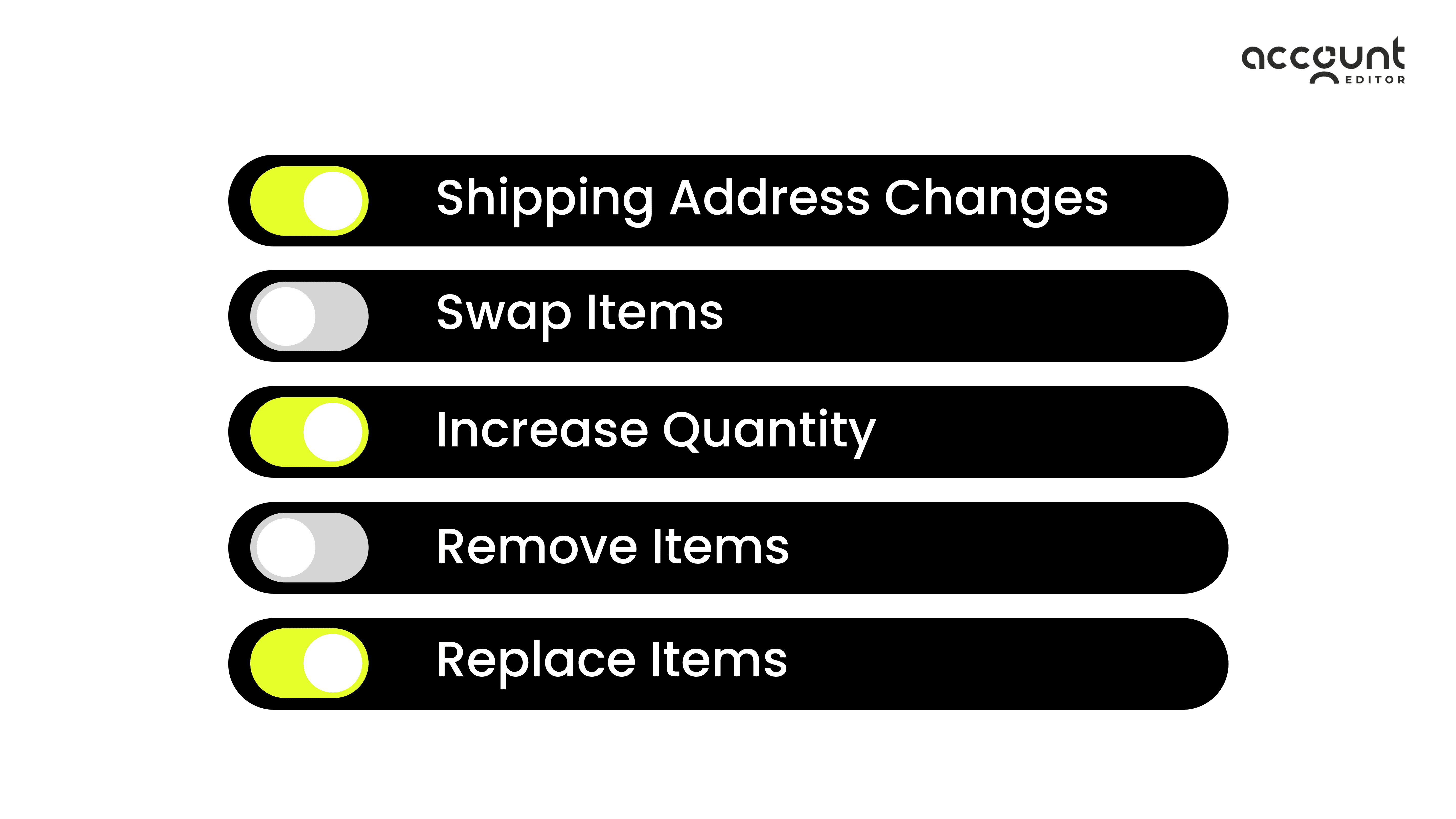
With customizable settings, you choose exactly what customers can edit, when they can edit it, and how those changes should behave behind the scenes. Nothing happens without your boundaries defining it.
This means:
• You decide how long the edit or cancellation window stays open.
• You control whether customers can add, remove, or swap items.
• You choose which products or orders are protected from edits.
• You determine whether shipping rates and taxes should be recalculated
Editing final sales and fraudulent orders
Self-service shouldn’t open the door to abuse.
That’s why advanced systems offer Fraud tag restrictions, Blocklist for high-risk products, Ability to disable edits for specific SKUs or orders, Address validation to prevent suspicious redirections. This maintains security while still giving genuine customers a better experience.
The future of eCommerce
The future of e-commerce is built around customer autonomy. Shoppers increasingly expect to manage their orders, update details, and solve issues instantly, without waiting for support. Brands that offer seamless self-service order editing and controlled post-purchase order changes are already setting a new standard for convenience.
As Shopify continues expanding post-purchase capabilities, the shift toward customer-led interactions will only accelerate. Stores that adopt these tools now gain a competitive edge: fewer order cancellations, fewer support tickets, and a smoother, more trustworthy post-purchase experience.
Simply put, the brands that win tomorrow are the ones that empower customers today—while staying fully in control of the rules behind the scenes.
Conclusion
Self-serve order editing is no longer a “nice to have”, it’s a critical upgrade for modern Shopify stores. It drives better customer experience, reduces avoidable order cancellations, minimizes support tickets, and empowers customers to control their shopping journey.
With tools like Account Editor, Shopify merchants can offer a seamless, intelligent post-purchase experience while keeping revenue protected and operations efficient.
The brands that invest in convenience win. And nothing delivers convenience like self-service order editing.