How Post-Purchase Experience Impacts Customer Retention on Shopify
Why Retention Is Won or Lost After Checkout
Most Shopify stores work hard to get customers to buy.
Ads bring traffic.
Product pages convince them.
Checkout completes the sale.
But then comes the main part:
Once payment is done, customers start waiting. They want clarity, updates, and reassurance that everything is on track. If anything feels confusing or out of their control, trust starts to fade, quietly.
This is why many retention problems, order cancellations, and drop-offs don’t start before payment. They start after checkout, during the post-purchase experience.
According to data shared on Shopify’s Enterprise blog, repeat customers represent about 21% of buyers and generate roughly 44% of total revenue, showing why what happens after the first purchase matters as much as the sale itself.
In this guide, we’ll break down:
What post-purchase experience really means on Shopify
Why it directly impact customer retention
How small issues after checkout lead to cancellations and churn
What Is Post-Purchase Experience on Shopify?
The post-purchase experience covers everything a customer goes through after placing an order, from the moment the payment is confirmed to when the product is delivered and any follow-up happens.
On Shopify, this experience is not limited to one screen or message. Instead, it happens across multiple touchpoints, including:
The thank-you page and order status page
Transactional emails and notifications
Customer account and order details
Shipping and delivery updates
Support interactions after checkout
This stage is important because it shapes how confident and reassured customers feel after buying. A clear and transparent post-purchase experience plays an important role in how customers feel about their purchase, especially when it comes to shipping updates, order tracking, and support interactions.Understand why post-purchase experience is the key to customer retention on Shopify.
1. Core Elements of the Post-Purchase Journey
Each part of the post-purchase journey plays a role in building or breaking customer confidence.
2. Order confirmation
Order confirmation is the first reassurance after checkout. Customers want to be sure their order was placed successfully and that key details such as items, address, and payment are correct.
3. Order management and changes
Mistakes happen. When customers can easily fix small issues, such as address errors or quantity changes, frustration decreases and confidence in the brand increases.
4. Shipping and delivery updates
Clear communication about shipping timelines and tracking helps customers know what to expect. Regular updates reduce anxiety during the waiting period.
5. Customer support touchpoints
When problems do occur, fast, clear, and transparent support helps protect trust and keeps the overall experience positive.
Why Post-Purchase Experience Directly Affects Customer Retention
A customer’s mindset changes the moment they complete a purchase.
Before checkout, they are deciding what to buy.
After checkout, they start thinking about whether they made the right decision.
This is where retention is shaped.
If customers feel reassured, informed, and supported after paying, they are more likely to trust the brand and return. If they feel unsure, stuck, or ignored, confidence fades quickly even if the product itself is good.
That’s why improving retention isn’t only about better ads or marketing campaigns. It’s about building trust after the purchase.
Small improvements in customer retention can have a meaningful impact on long-term profitability. This highlights why what happens after checkout plays such an important role in sustainable growth.
The Trust–Control Relationship After Purchase
After placing an order, customers look for two things: transparency and control.
They want to know what’s happening and feel confident they can act if something goes wrong.
This usually comes from:
Clear updates that explain what’s happening next
Self-service options that reduce the need to contact support
Simple corrections that allow small mistakes to be fixed easily
When customers feel out of control, frustration builds and retention drops.When they feel informed and empowered, they’re far more likely to return even if the experience isn’t perfect.
Key Post-Purchase Touchpoints That Influence Retention on Shopify
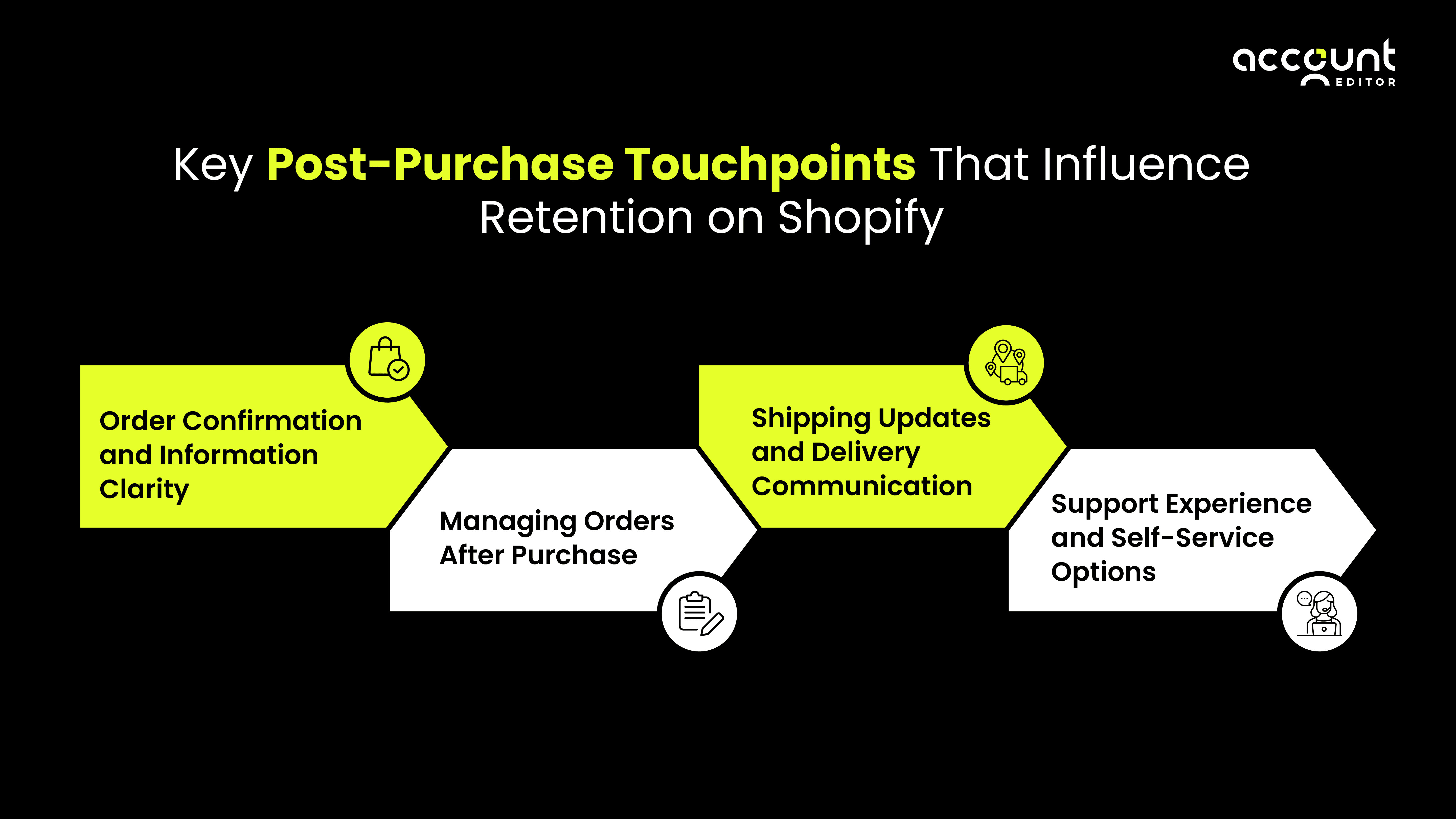
After checkout, customers interact with your store in several small but important moments. Each of these touchpoints can either reinforce trust or slowly weaken it, depending on how clear and helpful the experience feels.
1. Order Confirmation and Information Clarity
Order confirmation is more than just a receipt; it’s the first signal that reassures customers after checkout.
Clear confirmation messages help customers quickly verify that:
The order was placed successfully
The items and quantities are correct
The shipping and payment details are accurate
When this information is easy to understand and delivered on time, customers feel confident and less likely to question their purchase or cancel early.
2. Managing Orders After Purchase
It’s common for customers to notice small mistakes shortly after placing an order, such as an incorrect address, a wrong size, or a missing item.
When customers are forced to contact support for simple fixes, frustration builds. In contrast, stores that offer self-service options allow customers to resolve small issues on their own, which reduces friction and improves overall satisfaction.
This is why some Shopify merchants enable controlled post-purchase edits. Tools like Account Editor are often used in this context, not to encourage changes, but to help customers correct simple mistakes without needing to cancel orders or wait for support responses.
3. Shipping Updates and Delivery Communication
Shipping updates play a major role in how customers feel while waiting for their order.
Clear communication about shipping status and tracking helps customers understand what’s happening and what to expect next. When updates are missing or unclear, customers may assume something is wrong, even when it isn’t.
Consistent and transparent delivery communication reduces anxiety, lowers “Where is my order?” queries, and supports long-term trust in the brand.
4. Support Experience and Self-Service Options
Most customers don’t want to contact support for small issues.
Self-service options allow customers to solve basic problems quickly, while support teams can focus on more complex cases. This balance leads to:
Faster issue resolution
Less frustration for customers
Better overall experience
When support is easy to reach but is not the only option, customers feel more confident and in control.
Common Post-Purchase Mistakes That Reduce Customer Retention
Many customer retention problems don’t come from the product or the price. They come from small gaps after checkout that stores often overlook.
On their own, these issues may seem minor. But together, they slowly push customers away.
In many Shopify stores, these problems show up as avoidable post-purchase mistakes, especially around communication, order visibility, and customer control.
One common mistake is treating the post-purchase phase as support-only. When customers have to wait for email replies just to get basic answers, frustration builds.
Another issue is forcing customers to contact support for simple fixes, such as correcting an address or checking order status. When small tasks require extra effort, trust starts to fade.
Limited order visibility is another frequent problem. If customers can’t easily see what’s happening with their order, they may begin to worry that something is wrong.
Finally, delayed or unclear communication can break confidence. When updates arrive late or lack detail, customers are left guessing, and that uncertainty often leads to cancellations or hesitation to buy again.
These mistakes don’t always lead to complaints. More often, they lead to silent churn.
How Post-Purchase Issues Lead to Cancellations and Churn
Most order cancellations don’t happen because customers change their minds about the product.
They happen because customers feel stuck or unsure after checkout.
A small issue like a wrong address or missing update can quickly grow into a bigger problem if the customer doesn’t know how to fix it. When the path to resolution feels slow or unclear, cancelling the order becomes the easiest way out.
Over time, repeated post-purchase friction reduces confidence in the store. Customers may still receive their order, but the experience leaves a negative impression. This often results in:
Fewer repeat purchases
Lower trust in future orders
Higher long-term churn
For Shopify merchants, this is especially important because many post-purchase issues are preventable. Clear communication, visibility, and controlled self-service can stop small problems from turning into cancellations.
When post-purchase experience is designed with the customer in mind, fewer issues escalate, and retention improves naturally.
Metrics That Show the Impact of Post-Purchase Experience on Retention
Post-purchase experience affects retention in ways that can be clearly seen through a few key metrics. These numbers help merchants understand whether customers feel confident enough to return.
1. Repeat purchase rate
Repeat purchase rate shows how many customers come back to buy again. It’s one of the clearest signs of trust and satisfaction.
When customers feel reassured after checkout through clear updates, smooth delivery, and fewer issues, they are more likely to place another order. A weak post-purchase experience, on the other hand, often results in one-time buyers who never return.
2. Customer lifetime value (CLV)
Customer lifetime value reflects the total revenue a customer generates over time.
CLV grows when customers trust the buying process and feel comfortable ordering again. Even small improvements in post-purchase experience can increase CLV by encouraging repeat purchases instead of one-time transactions.
3. Cancellation rate
Cancellation rate is a direct signal of post-purchase friction.
Higher cancellation rates often point to issues such as unclear communication, lack of order visibility, or difficulty fixing simple mistakes. When customers feel unsure or stuck after checkout, cancelling the order can feel like the easiest option.
4. Post-purchase support ticket volume
Support ticket volume after checkout shows how much effort customers need to resolve issues.
A high number of post-purchase tickets often suggests that customers lack clear information or self-service options. When communication and visibility improve, support volume usually drops as customers can find answers on their own.
5. Linking Post-Purchase Experience to Retention Metrics
Breakdowns in the post-purchase flow, such as late updates, unclear order status, or limited control, tend to show up quickly in these metrics.
Lower repeat purchase rates, rising cancellations, and higher support volume often share the same root cause: friction after checkout. Improving post-purchase experience helps stabilise these metrics and supports long-term revenue growth.
How High-Retention Shopify Stores Optimise Post-Purchase Experience
High-retention Shopify stores don’t treat post-purchase as a background operation. They treat it as part of the full customer journey.
Instead of reacting only when problems occur, these stores design post-purchase experience intentionally. They focus on:
Clear and timely communication after checkout
Self-service options for simple post-purchase needs
Reducing unnecessary dependency on support teams
Tracking retention-related metrics regularly
By doing this, they create a calmer and more predictable experience for customers. Over time, this builds trust, reduces friction, and encourages repeat purchases.
The Role of Self-Service in Improving Post-Purchase Retention
Self-service plays a quiet but important role in post-purchase retention.
When customers can fix small mistakes on their own, they feel more confident and less dependent on support. This sense of control reduces frustration, especially during the waiting period after checkout.
For merchants, self-service also helps lower post-purchase support volume. Fewer tickets mean faster resolution for complex issues, while customers get answers without delays. Over time, this balance leads to a smoother experience, one that customers are more likely to trust and return to.
Post-Purchase Experience vs Customer Acquisition
Acquiring new customers is important, but it does not solve retention problems on its own.
When customers leave after their first order, stores are forced to keep spending on ads just to maintain the same level of revenue. In contrast, improving post-purchase experience helps reduce churn and encourages repeat purchases, which supports long-term growth more sustainably.
Industry discussions across eCommerce consistently highlight that retaining existing customers is generally more cost-effective than acquiring new ones. This is why many stores focus on strengthening the experience after checkout, not as a marketing tactic, but as a way to protect the value of every customer they acquire.
Key Takeaways for Shopify Merchants
Post-purchase experience has a direct impact on customer retention
Many retention challenges begin after checkout, not before
Small post-purchase issues can quietly turn into cancellations and churn
Self-service and clear communication help reduce friction
Retention improves when post-purchase is treated as part of the full customer journey